
On November the 7th New Zealand headed to the polls in General election.
Three years of a National-ACT-NZ First government has mean nonstop attacks on workers, students and youth. There were massive job cuts in the public sector and social services. Pay equity and fair pay legislation introduced by the previous Labour government were cancelled. The fees-free year of tertiary education was cancelled.

Throughout the term of government, right-wing politicians tried to start culture wars to distract from the class issues. In 2024 David Seymour introduced the infamous “Treaty Principles bill” to parliament which sought to limit Maori rights that were guaranteed under the treaty of Waitangi. This caused a backlash and big marches in support of the Treaty. Passing such blatant racism into law was a bridge too far for the National party, although as part of their coalition agreement with Act they agreed to put the bill up for debate. In the end they voted against it.
Not to be outdone, NZ First launched their so-called “war on woke”, attacking Asian immigrants and trans people. Their ridiculous “Definitions of Woman and Man” bill is currently being debated in a select committee. Whether or not this bill meets the same fate as the Treaty principles bill remains to be seen.
The antics went into overdrive during the election campaign. But ACT and NZ First are part of the governing coalition, not anti-establishment outsiders. Their culture wars did not make much traction outside of their existing reactionary supporters, and were widely seen as a distraction.
The most important issues for voters are the cost of living and the economy, healthcare, and housing. Unemployment is at 5.7%, an 11 year high. But the bourgeois parties have no answers.
The discrediting of the government would usually mean an increase in support for Labour as the default opposition party. In May, opinion polls showed support for National had sunk below 30% and Labour rising above 35%. Labour’s strategy seems to have been to gain support by simply doing nothing. Up until August, the upcoming election was characterised by almost complete indifference.
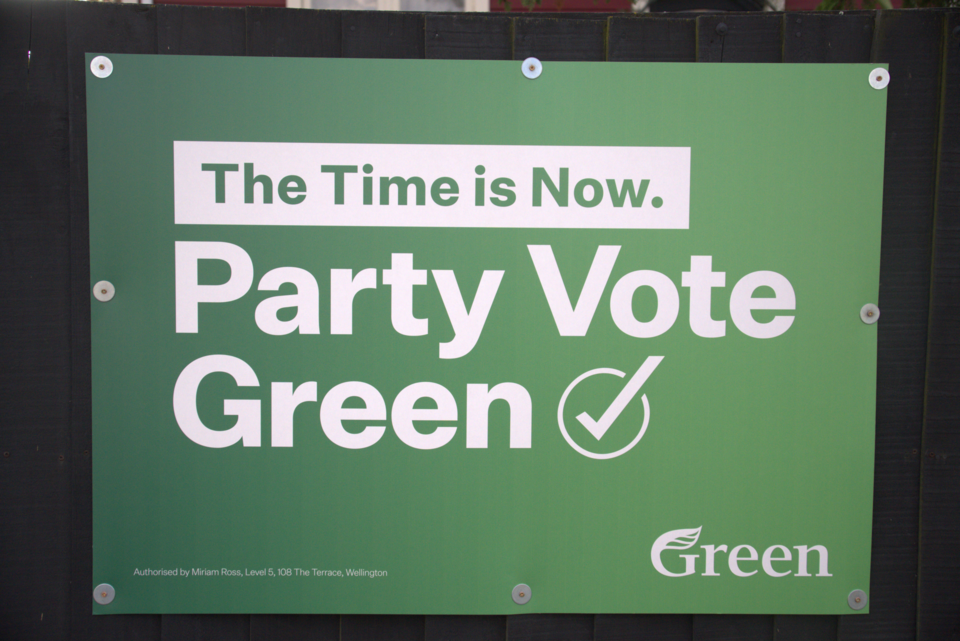
However in August, the Opportunity Party (TOP), a small centrist party with no MPs, rose in the opinion polls. The Green party to the left of Labour also climbed in the polls at Labour’s expense.
Elections give a snapshot of the electorate at a particular time. Preliminary results on election night show the traditional parties (National and Labour) in a dead heat, each with just over 29% support each. Support for the National party dropped almost 9 points compared to 2023, but much of its support was redistributed among its rightwing coalition partners. At the end of election night the coalition parties scraped together 50% of the vote but will likely have a 1-2 seat majority thanks to an overhang.
Since 1996 elections in NZ have been held under the rules of MMP (mixed member proportion) in which one casts 2 votes: an electorate vote and a party vote. Of 120 seats in parliament, 71 are electorate seats (7 Maori electorates and 64 general electorates). The allocation of remaining seats is determined by the party vote. (For example: a party winning 10% of the party vote entitles them to 12 (out of 120) seats in parliament. If they won 5 electorates, they would be assigned 7 more seats. If they won 12 electorates, they are not entitled to any more seats.)
If a party wins more electorates than its party vote, or an independent MP with no party affiliation wins an electorate, the extra electorate seats are not considered in party vote calculations and are simply added to the 120, creating an overhang. For example, if a party won 2 electorates but was only entitled to 1 seat, then parliament would expand to 121 seats—an overhang of 1 seat. Small overhangs of this sort have been quite common.
The circumstances of the 2026 election have produced a massive overhang, which will be anywhere from 9 to 11 seats once all the special votes are counted.
Te Pati Maori (the Maori party) which was originally polling at around 7%, started tearing itself apart at the end of 2025. After the dust settled on the infighting, 2 of its MPs had been expelled and its support in opinion polls had plummeted to less than 1%. Its only path into parliament was via an electorate. It campaigned hard in the Maori electorates, encouraging Maori voters to ‘split their vote’, giving their party vote to either the Greens or Labour. It ended up winning 5 of the 7 Maori electorates and 0.6% of the party vote.
On the right, the party vote for National showed a big decline, but they managed to hold on to most of their electorates. On election night they were winning in 42 electorates although their party vote entitles them to only 36 seats.
The overhang on the right was encouraged in response to the Maori party’s campaign. In the last week before the election, rightwing billionaire (and major National Party donor) Nick Mowbray funded a massive ad campaign calling on rightwing voters to also ‘split your vote’ – electorate vote National, and party vote ACT or NZ First, to engineer a coalition majority.
As a result, four cabinet ministers who were relying on National’s party vote (including the Minister of Finance, Nicola Willis) are now out of parliament while backbench electorate MPs remain. Despite this setback, the National-ACT-NZ First coalition will probably limp back into power with a 1 or 2 seat majority.
Table of Preliminary results
Party | Party vote % | Electorates won | Total Seats |
National | 29.2 | 42 | 42 |
ACT | 10.9 | 1 | 13 |
NZ First | 9.8 | 0 | 12 |
Labour | 29.4 | 21 | 36 |
Green | 13.3 | 2 | 16 |
Maori | 0.6 | 5 | 5 |
TOP | 6.0 | 0 | 7 |
TOTAL | 71 | 131 (overhang of 11) |
A deeper analysis of the election results will give more insights. But the fact that neither of the two major parties got over 30% (which has never happened before), and the rapid rise of TOP, shows that wide layers are sick of the status quo.
Turnout was down to 75%, the second lowest in history for a general election. The government also made changes that suppressed turnout for youth. Same-day voter registration was abolished—voters were now required to sign up for the electoral roll two weeks before voting day. Only 74% of 18-24 year olds were enrolled by the deadline. In what looks like suspicious timing, a few days after the deadline had passed, new rules around the jobseeker benefit came into force that made thousands of 18-19 year olds ineligible for this support – if their parents earned more than $67,225 they should rely on their parents to support them instead!
There will be no honeymoon for a re-elected National-ACT-NZ First government, which after 3 years of counter-reforms is widely hated.
More of the same is already intolerable. But what is on the horizon is not just more of the same, but worse. The world economy is teetering on the brink; any number of things could push it over the edge. The Straits of Hormuz remain closed as the Iran conflict remains locked in a stalement. The AI stockmarket bubble is also set to burst at some point.
The bourgeoisie require a strong government under their control that can carry out deep cuts and attacks when the situation demands it. But the culture war antics of ACT and NZ First, the electoral shenanigans, and the razor thin majority, mean that the political authority of this coalition will be starting at zero and rapidly head into negative territory, even among its own voters.
The reformists in the union movement and left parties staked everything on the “get out the vote” campaign. There is some demoralisation after it came up short. But for the mass of workers, the disappointment of the election will quickly wear off; they will not be content to sit back for another three years and accept even worse cuts than before. They will demand action to stop it. Given a bold lead, they can very rapidly move into struggle. Even without leadership, events can push them into action.
A second term of National-ACT-NZ First will be even more unstable than before and could easily collapse at its first real test. Back in 1998 after the Asian financial crisis, the first National-NZ First coalition government collapsed when Winston Peters walked out after demagogically opposing the privatisation of Wellington Airport.
There is a small possibility that Labour, Greens, Te Pati Maori and TOP flip enough seats after special votes are counted to create a hung parliament, or even a one seat majority for the opposition parties. But a four party coalition of Labour-Green-TOP-Maori would be even more unstable than National-ACT-NZ First. From day one the capitalist class would be undermining such a government using all weapons at their disposal (media, economic, etc.) to prepare their overthrow and the return of the bourgeois parties.
Whatever the final makeup of parliament, things are heading towards an explosion of the class struggle in the coming period. The movements in Europe against austerity and militarism and against ICE in America will inevitably be replicated here. Reformism is already in crisis; political turmoil could lead to splits and the emergence of mass left wing currents (in the unions, left parties, or even some accidental formation). The last time this happened was in the early 1990s with the rise of the Alliance.
Already, there is a significant layer of youth and workers that are already radicalised. We need to build a disciplined force grounded in marxist theory that can intervene effectively to win the best elements to communism.
Labour’s campaign slogan was “Better starts now.”
We say, “The Fight for communism Starts Now!”
Image references
[[File:Voting sign Wellington railway station 2026.jpg|Voting_sign_Wellington_railway_station_2026]]
SuperSight, CC BY-SA 4.0, via Wikimedia Commons
